
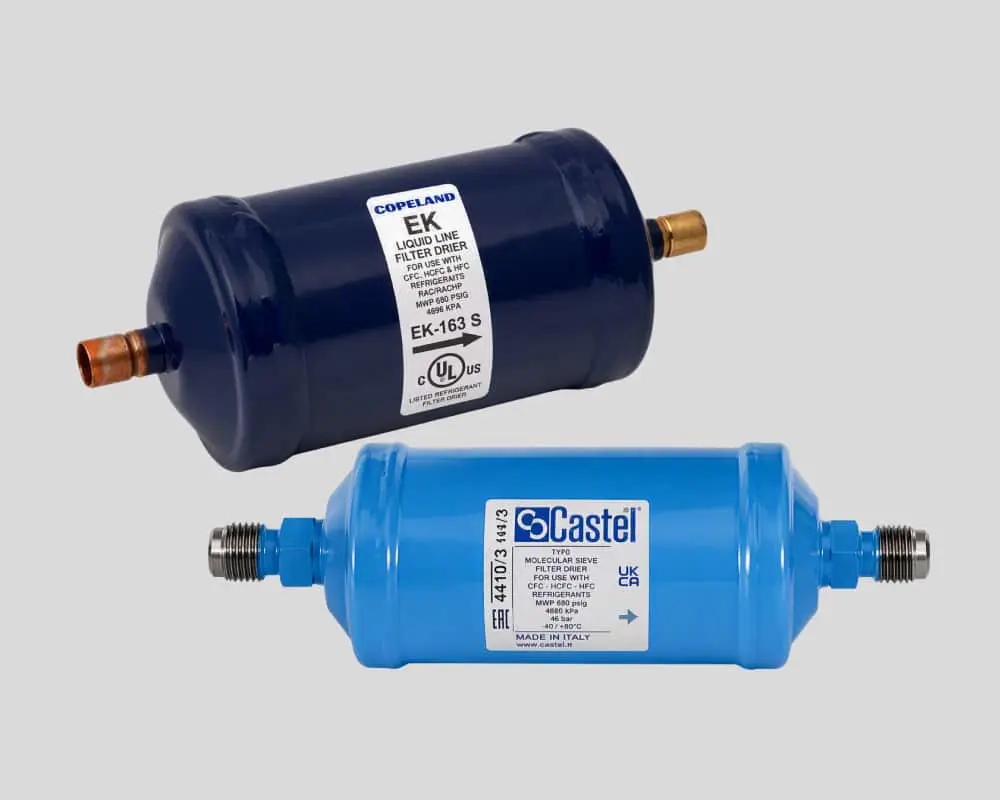
Filter drier comparison: Understanding the differences
Whether you're specifying a new system or replacing a filter drier during servicing, understanding the differences between filter drier types is key to protecting system performance and compressor life.
What is a filter drier?
Filter driers are used in refrigeration and air conditioning systems to filter unwanted solids and moisture from the system. There are many types of filter driers and they are made specifically for different parts of a system and different needs.
Why choosing the right filter drier matters
Not all filter driers are designed to do the same job. Some are optimised for moisture removal, while others excel at capturing acids created by compressor failures. Choosing the wrong filter drier can leave contaminants circulating through the system, increasing the risk of blockages, compressor damage and costly downtime. Here, we compare the most common filter drier types and explains where each should be used.
Liquid line vs suction line filter driers: what's the difference?
Liquid line filter driers
Best for: Everyday system protection Installed in the liquid line, these filter driers are designed to remove:
Moisture
Acids
Solid contaminants
Their primary role is to protect expansion devices and compressors from contamination before refrigerant reaches critical system components. Choose a liquid line filter drier when:
Installing new equipment
Opening a system for service
Replacing a filter drier as part of routine maintenance
Suction line filter driers
Best for: System clean-up and compressor protection Suction filter driers are typically installed after compressor burn-out events to capture:
Acid contamination
Carbon deposits
Sludge
Debris
Suction filter driers are generally considered a temporary solution and should be removed once the system has been cleaned.
Choose a suction filter drier when:
Replacing a burnt-out compressor
Removing severe contamination
Conducting system clean-up procedures
Which is better?
Neither is “better”. Liquid line and suction line filter driers perform different functions – and are often used together following major compressor failures.
Molecular sieve vs activated alumina: which removes more contamination?
Molecular sieve
Strength: Moisture removal Molecular sieve offers extremely high water absorption capacity, making it the preferred choice when moisture control is the primary concern. Pros
Excellent moisture removal
Protects expansion valves from ice formation
Helps prevent acid formation
Best for
New installations
Moisture-prone systems
General dehydration
Activated alumina
Strength: Acid removal Activated alumina is highly effective at capturing acids circulating within refrigeration systems. Pros
Excellent acid absorption
Helps protect compressors
Commonly used in OEM applications
Best for
Systems with low moisture exposure
Controlled manufacturing environments
Acid clean-up applications
Which is better?
Molecular sieve for moisture removal. Activated alumina for acid removal. In cases where moisture and acid exist together, your best option is a filter drier that combines both materials.
OEM vs service replacement filter driers
OEM filter driers
Original equipment manufacturers (OEMs) often use filter driers containing predominantly activated alumina. This works because manufacturing conditions are tightly controlled and moisture contamination can be minimised.
Service replacement filter driers
Service replacement filter driers are designed for real-world conditions where moisture may already have entered the system. Most contain a combination of molecular sieve and activated alumina. This allows technicians to tackle both moisture and acid contamination simultaneously.
Which is better?
For field servicing, replacement filter driers generally provide broader contaminant protection because they target both moisture and acid.
Compacted bead vs solid core filter driers
Compacted bead filter driers
Compacted bead filter driers are best for general refrigeration and air conditioning service work and are the most common service replacement option. They typically contain a blend of molecular sieve and activated alumina in bead form.
Benefits
Excellent moisture removal
Effective acid capture
Versatile field performance
Solid core filter driers
Solid core filter driers use a bonding material to produce a solid core. They are found in:
Some hermetic filter driers
All demountable filter drier shell systems
Benefits
Strong structural integrity
Consistent filtration performance
Suitable for larger commercial systems
Which is better?
For routine service work, compacted bead filter driers are often preferred. For larger systems using replaceable cores, solid core designs are typically the industry standard.
Hermetic vs demountable filter driers
Hermetic filter driers
Used on small to medium systems. They have flare or solder connections. Typically suited for:
Pipe sizes up to ¾"
Residential systems
Light commercial refrigeration
Demountable shell filter driers
Designed for larger systems with replaceable cores. The ‘demountable’ name speaks to their ability to be pulled apart. They have replaceable filter drier cores. Typically suited for:
Pipe sizes ⅞" and larger
Commercial refrigeration
Industrial plant applications
Which is better?
Larger systems benefit from the flexibility and lower lifecycle cost of demountable shells, while hermetic filter driers remain the practical choice for most smaller installations.
Which filter drier should you choose?
Requirement | Recommended filter drier |
New installation | Liquid line filter drier |
Routine service work | Mixed desiccant replacement filter drier |
Moisture removal | Molecular sieve |
Acid removal | Activated alumina |
Compressor burn-out | Suction burn-out filter drier* |
Small systems | Hermetic filter drier |
Large commercial systems | Demountable shell filter drier |
Unknown contamination levels | Compacted bead mixed-core drier |
*Note: Suction burn-out filter driers are a temporary clean-up solution and should be removed after a few weeks of operation, once acids and contaminants have been cleared from the system.
Pro tip
Even small amounts of moisture can impact system performance and reliability. Because moisture often enters during maintenance, replacing the liquid line filter drier and carrying out a thorough vacuum are essential steps before recommissioning the system.
The bottom line
There isn’t one “best” filter. Because not all filter driers are designed for the same purpose. Choosing the right one comes down to the specific requirements of the system and the type of protection needed. For most service technicians, a mixed-desiccant liquid line filter drier provides the broadest protection against both moisture and acid contamination. However, a dedicated suction burn-out filter drier remains essential for protecting replacement equipment after compressor burn-out events.
Need the right filter drier for the job? Browse the Castel filter drier range and the Copeland filter drier range, or speak to your local ACTROL branch team for expert advice.
Share